WACC Calculator (Weighted Average Cost of Capital)
Enter the value of your equity and debt, what each costs and the tax rate to get the weighted average cost of capital, with every step shown.
This WACC calculator works out the weighted average cost of capital. You enter the market value of the equity and the debt, the cost of equity, the cost of debt before tax and the tax rate, and it returns the WACC as a percentage. It shows the capital mix and the cost of debt after tax. It runs in your browser with no sign-up, and nothing you type is uploaded.
WACC is the average rate a company pays to finance its assets, weighted by how much of each kind of capital it uses. Businesses use it as the discount rate when they value a project or a company, and as the hurdle rate that a project’s return has to beat. The result updates as you type, so you can see what a different debt share does.
How to use the WACC Calculator
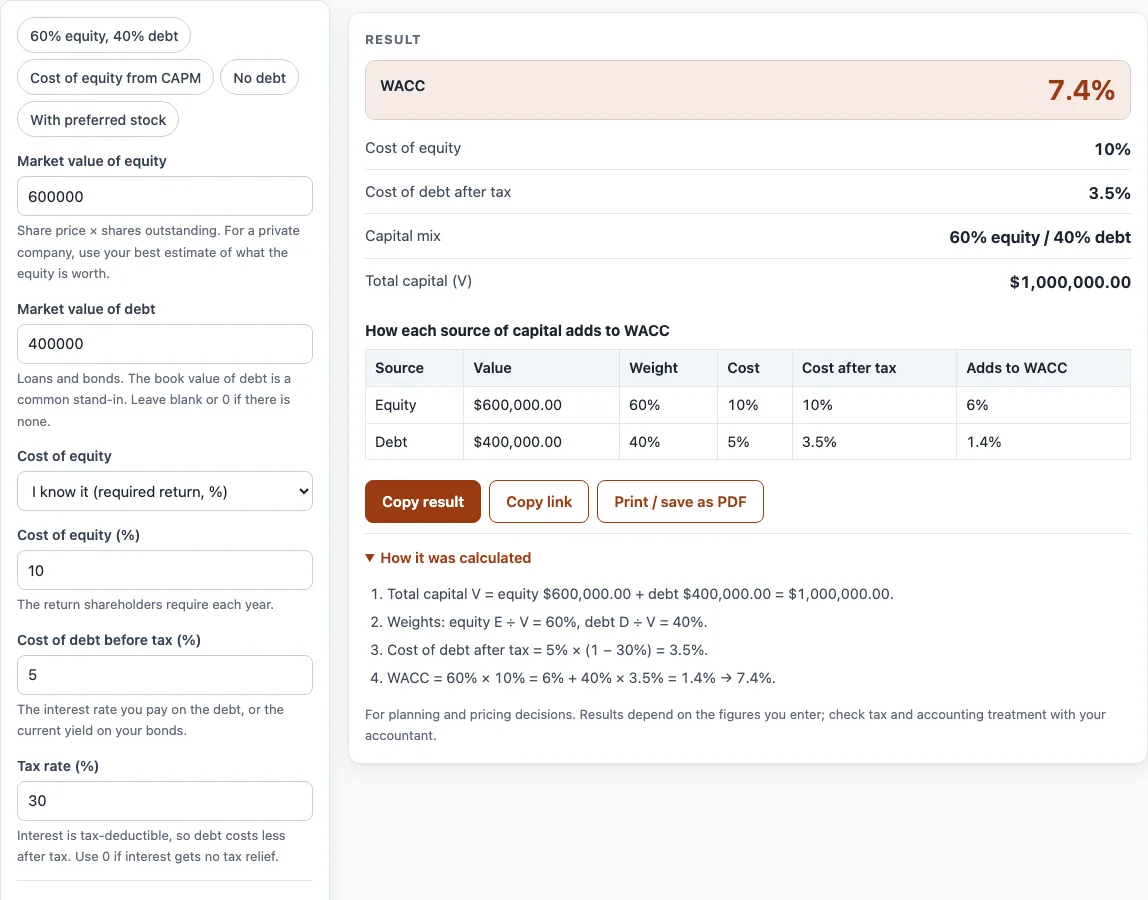
- Type the Market value of equity. For a listed company this is the share price times the shares outstanding.
- Type the Market value of debt. Leave it blank or 0 if the business has no debt.
- Under Cost of equity, choose I know it (required return, %) and type the Cost of equity (%), or choose Work it out with CAPM and type the Risk-free rate (%), the Beta and the Equity risk premium (%).
- Type the Cost of debt before tax (%), the interest rate paid on the debt, and the Tax rate (%).
- Optionally, under More options, add the Market value of preferred stock (optional) and the Cost of preferred stock (%), and set the Currency.
- Read the WACC, the Cost of equity, the Cost of debt after tax and the Capital mix. The table shows what each source adds to the WACC, and How it was calculated gives each step.
The four example buttons at the top of the form fill in a realistic case, and Reset restores the starting example. Below the result, Copy result copies the figures, Copy link keeps all your inputs in the page address so the same result reopens later, and Print / save as PDF prints the inputs, result, steps and date.
What is the WACC formula?
The formula weights the cost of each source of capital by its share of the total:
WACC = E/V × Re + D/V × Rd × (1 − t)
Here E is the market value of equity, D the market value of debt and V = E + D. Re is the cost of equity, Rd the cost of debt and t the tax rate. Debt is taken after tax because interest is usually tax-deductible, so each unit of interest costs the company less than its face amount. With preferred stock, add a third term, P/V × Rp.
Take a company with equity worth 600,000 and debt worth 400,000, a cost of equity of 10%, a cost of debt of 5% and a 30% tax rate. The total capital V is 1,000,000. Equity is 60% of it and debt 40%. The after-tax cost of debt is 5% × (1 − 0.30) = 3.5%. WACC = 0.60 × 10% + 0.40 × 3.5% = 6% + 1.4% = 7.4%.
How do you find the cost of equity with CAPM?
Shareholders do not receive a fixed rate, so the cost of equity has to be estimated. The capital asset pricing model does it as the risk-free rate plus beta times the market risk premium:
Re = risk-free rate + beta × equity risk premium
With a risk-free rate of 4%, a beta of 1.2 and an equity risk premium of 5%, Re = 4% + 1.2 × 5% = 10%. A beta above 1 means the stock moves more than the market, so it carries a higher cost of equity. The calculator accepts any rates you choose: it does not look up a current risk-free rate, beta or premium, because they change and depend on the market and the period you use.
Why use market values rather than book values?
The weights should reflect what investors would pay for each source of capital today, which is the market value. The market value of equity is the market capitalisation. For debt, the book value is a common stand-in when the debt does not trade. For a private company, use your best estimate of what the equity is worth, since the book value of equity can be far from it.
How is WACC used?
WACC is the discount rate for a project that carries about the same risk as the company as a whole. A project whose return is above the WACC creates value, and one below it destroys value. Use it as the rate in the IRR calculator to get a net present value, or as the hurdle rate against which you compare the project’s IRR.
WACC has limits. It is an estimate, and it is only as good as the inputs. It is the right rate only for projects of similar risk to the company, and the cost of equity in particular is a judgement, not a measurement.
Sources
- Wikipedia, Weighted average cost of capital (checked October 2026) — the WACC formula with tax and preferred stock, and the use of market values for the weights.
- Wikipedia, Capital asset pricing model (checked October 2026) — expected return = risk-free rate + beta × (market return − risk-free rate).
- Every formula is worked through by hand in the tool’s tests (at least five reference cases).
Worked examples
| Input | Result |
|---|---|
| equity $600,000.00, debt $400,000.00 | WACC 7.4% (60% equity / 40% debt) |
| equity $600,000.00, debt $400,000.00 | WACC 7.4% (60% equity / 40% debt) |
| equity $1,000,000.00, debt $0.00 | WACC 12% (100% equity / 0% debt) |
| equity $500,000.00, debt $300,000.00 | WACC 8.322% (50% equity / 20% preferred / 30% debt) |
Calculated by the tool above with these values.
Frequently asked questions
What is a good WACC?
There is no single good number. A lower WACC means cheaper financing, and what is normal depends on the industry, the country and the interest rates of the day. Compare a company’s WACC with its past figures and with similar companies, and compare a project’s return with it.
Can the WACC be lower than the cost of debt?
Yes. After tax, debt is the cheapest source, so the WACC can sit below the pre-tax cost of debt when the debt share is large and the tax rate is high. The mix of equity and debt is what moves it.
Do I have to use CAPM?
No. If you already have a required return on equity, choose I know it and type it. CAPM is an option when you need to estimate the cost of equity from a beta.
What tax rate should I use?
Use the rate at which the company’s interest is tax-deductible, usually the marginal corporate tax rate. If interest gets no tax relief, use 0 and the debt is taken at its full rate.
What if the company has no debt?
Leave the debt blank or 0. The WACC then equals the cost of equity, and the calculator says so.
Is my information sent to a server?
No. Everything runs in your browser and nothing you type is uploaded. Nothing is stored on a server.
Related tools
- IRR calculator — internal rate of return and NPV from cash flows.
- ROI calculator — return on investment and annualized ROI.
- Payback period calculator — simple and discounted payback.
- Accounting rate of return calculator — ARR: average annual profit ÷ average investment.
- Break even calculator — break-even units and sales with a chart.
- Net margin calculator — net profit and net profit margin after all costs.