ROI Calculator (Return on Investment)
Enter what you invested and what you got back to get the ROI, and the period to get the annualized return.
The ROI Calculator works out return on investment (ROI) as a percentage, showing how much you gained or lost compared with what you put in. Enter the amount invested and the final value, and it also returns net profit, a total that includes extra income or costs, and an annualized ROI when you give a holding period. It runs in your browser, is free, and needs no sign-up. Nothing you type is uploaded. Use it for business purchases, stock and property investments, or any project where you want one clear figure to compare options.
Use it to find ROI for a machine, a marketing campaign or a trade show; figuring ROI by hand takes three steps, and the tool shows each of them so you can estimate return on investment before you commit and determine return on investment afterwards.
How to use the ROI Calculator
- Type the total cost of the investment into Amount invested.
- Enter what the investment is worth at the end, or what you received for it, in Amount returned (final value).
- In Additional income (+) or costs (−), enter dividends, rent or other income as a positive number. Enter fees, taxes or upkeep as a negative number, such as -200.
- Open Holding period and choose one of four options: Not needed (total ROI only), Years, Months, or Start and end dates. Fill in Years held, Months held, or both Start date and End date (written as YYYY-MM-DD) to match your choice.
- Pick your Currency from the list.
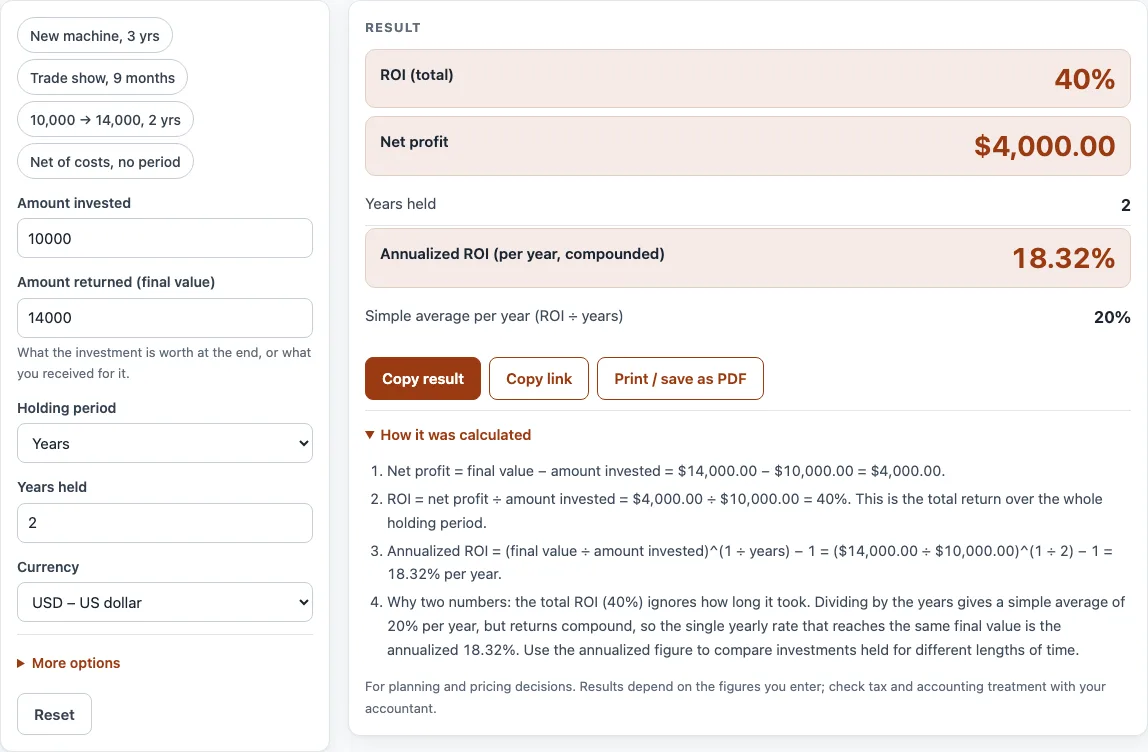
- Read the results: ROI (total), Net profit, Final value incl. extra income, Years held, Annualized ROI (per year, compounded), and Simple average per year (ROI ÷ years).
The result updates as you type. The example buttons at the top of the form fill in a realistic case so you can see how the fields work, and Reset restores the starting example. Some fields sit under More options. Below the result, Copy result copies the figures, Copy link saves every input in the page address, and Print / save as PDF prints the inputs, result, calculation steps and date. The How it was calculated list shows the formula with your own numbers.
What is the meaning of return on investment?
Return on investment is a measure of how much money an investment made or lost, relative to the amount put in. It is often called return over investment, and the ROI formula is the usual way to express it as a percentage.
What is the ROI formula?
The ROI formula is (amount returned − amount invested) ÷ amount invested × 100. Using the example of investing 10,000 and getting back 14,000, the net profit is 4,000, and the ROI is 4,000 ÷ 10,000 × 100 = 40%. This is the same equation the tool applies, and it is the basic way to calculate an ROI.
What does 100 ROI mean?
A 100% ROI means the net profit equals the amount invested. The final value is double the starting amount. An ROI above 100% means the investment more than doubled, and a ROI below 0% means a loss.
What does ROI percentage mean?
The ROI percentage is the ROI expressed out of 100, so 25% means you earned 25 units of profit for every 100 units invested. ROI is also a ratio, because it compares profit to cost. Some people write it as a decimal, such as 0.40 for 40%, but the percentage form is the usual one.
What does net ROI mean?
Net ROI is the return after costs have been taken off. Include all fees and running costs in the investment, or subtract them from the return, otherwise the ROI is overstated. The tool’s Additional income (+) or costs (−) field is there for this purpose.
What is ROI analysis?
ROI analysis is the process of comparing ROI figures for different options to decide which is worth more. It works best when each option uses the same period and the same costs. Because simple ROI ignores time, a short project and a long one can look equal even when they are not.
What does estimated ROI mean?
An estimated ROI is calculated from expected figures rather than final results. The formula is the same, but the answer depends on how good the estimates are. Treat it as a planning figure and update it when real numbers arrive.
Why is annualized ROI different from total ROI?
Simple ROI does not account for time, so 40% over two years is not the same as 40% over ten years. Annualized ROI, also called the compound annual growth rate, is (final ÷ initial)^(1 ÷ years) − 1. For 10,000 to 14,000 over 2 years, that is 1.4^0.5 − 1 = 18.32% a year, not 20%. This makes it useful for comparing investments held for different lengths of time.
How do you compute rate of return per year, and what is the accounting rate of return formula?
To compute return on investment per year, use the annualized ROI above. The accounting rate of return formula is different: average annual accounting profit ÷ initial investment × 100 (some textbooks divide by the average investment instead). It uses accounting profit after depreciation rather than cash, and it ignores timing, so use it alongside the figuring return on investment steps on this page rather than instead of them.
Sources
- Return on investment and accounting rate of return: OpenStax Principles of Accounting, Volume 2: Managerial Accounting (free textbook), capital budgeting.
- Annualized ROI = (final ÷ initial)^(1/years) − 1 (compound annual growth rate).
- Every formula is worked through by hand in the tool’s tests (at least five reference cases per calculator).
Worked examples
| Input | Result |
|---|---|
| $10,000.00 → $14,000.00 | ROI 40%, annualized 18.32% |
| $25,000.00 → $33,000.00 | ROI 32%, annualized 20.33% |
| $5,000.00 → $5,300.00 | ROI 6% |
| €40,000.00 → €52,000.00 | ROI 30%, annualized 9.13% |
| $8,000.00 → $6,000.00 | ROI −25%, annualized −9.14% |
Calculated by the tool above with these values.
Frequently asked questions
Is ROI the same as rate of return?
They are closely related. ROI is usually the total gain as a percentage of the amount invested, while a rate of return is normally expressed per year. Check which one a source means before comparing numbers.
Can I use the ROI Calculator for rental property?
Yes. Enter the purchase and running costs as the amount invested, the value at sale or the total you received as the final value, and rent or other income in the extra income field as a positive number. Upkeep and fees go in as negative numbers.
What does a negative ROI mean?
A negative ROI means the investment lost money. The ROI (total) result is still correct, and the tool shows a warning when the investment lost money in total.
Why does the tool sometimes show a warning about annualized ROI?
The tool warns when the period is very short, because annualizing a short gain assumes you could repeat it every year. It also warns when a very short or very large gain produces an extreme annual figure. Use those results as comparisons, not forecasts. If the final value is negative, the annualized rate cannot be calculated.
Does ROI account for when cash came in or out?
No. ROI does not reflect the timing of cash flows within the period, and it does not measure risk. For projects with cash flows spread over several years, use NPV or IRR instead.
Is my data sent anywhere when I use the calculator?
No. Everything runs in your browser, and nothing you type is uploaded.
Can I use the results in a business plan or quote?
Yes. Results may be used in commercial work, such as price lists, quotes and business plans, with no attribution required.
Related tools
- IRR calculator — internal rate of return and NPV from cash flows.
- Payback period calculator — simple and discounted payback in years.
- Break even calculator — break-even units and sales with a chart.
- Profit margin calculator — profit, margin and markup from cost and price, or the price for a target margin.
- Net margin calculator — net profit and net profit margin after all costs.
- Operating margin calculator — operating profit (EBIT), operating margin and EBITDA.