Cost per Unit Calculator (Price per Unit)
Enter a price and a quantity to get the cost per unit, or compare offers to find the cheapest per unit.
A cost per unit calculator divides a total cost by the number of units to show what one unit costs. This Price Per Unit Calculator does that in your browser, for free, with no sign-up. Enter a total price and a number of units, and the result updates as you type.
The same page also compares up to four offers, converts prices to a unit such as a gram, litre or single item, and estimates production cost per unit from fixed and variable costs. Nothing you type is uploaded. The steps below show how to use each option, and the explanation after them covers the formula behind the results.
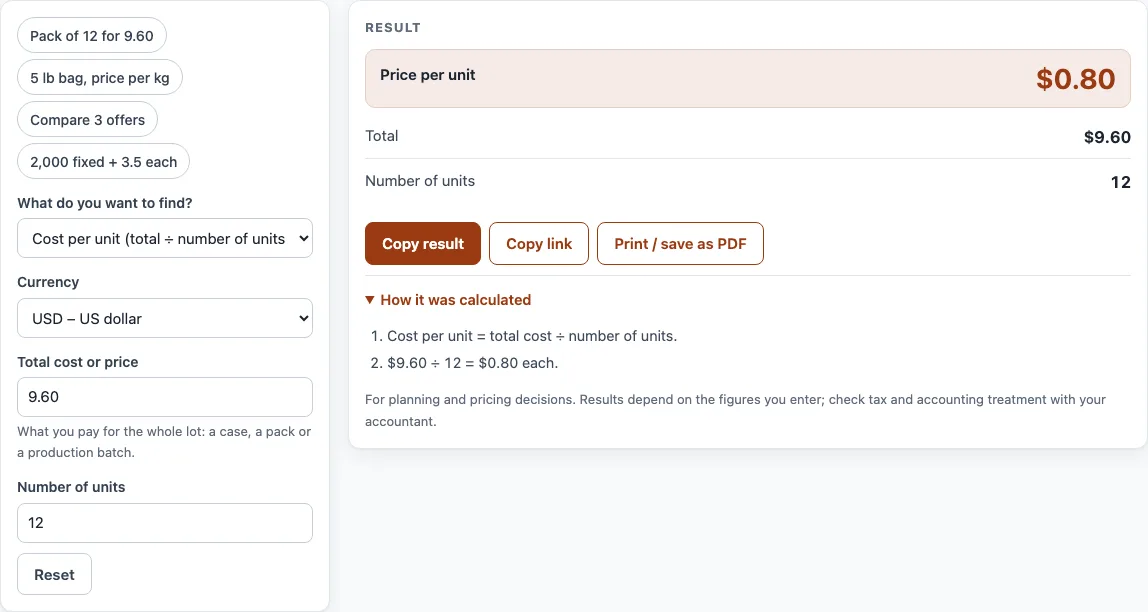
How to use the Price Per Unit Calculator
- Under What do you want to find?, choose one option: Cost per unit, Price per kg, lb, litre, gallon, m or ft, Compare up to 4 offers, or Production cost per unit (fixed + variable).
- Under Currency, pick the currency you are working in.
- Enter the Total cost or price and the Number of units. For a pack, enter the Amount in one pack, and leave Number of packs (optional) empty if you have one pack.
- Under Show the price per, choose the unit you want the result in, such as g, kg, L or ft.
- Read the Price per unit and Total result lines.
To compare offers, choose Compare up to 4 offers. Set Compare the price per to a unit, or to “each” if you count items. Then fill in Offer A price and Offer A quantity, and do the same for Offers B and C. Offer D is optional. Read Cheapest offer, Its price per unit, and the difference lines. For production cost, enter Fixed costs for the run, Variable cost per unit, and Units produced. Read Total variable cost and Fixed costs share of the total. Use the example buttons at the top of the form to load a realistic case, and Reset to return to the starting example. Some fields sit under More options.
What is a cost per unit calculator?
A cost per unit calculator divides the total cost by the number of units. The formula is cost per unit = total cost ÷ number of units. For example, a pack of 12 that costs 9.60 works out to 9.60 ÷ 12 = 0.80 each.
How do you compare unit prices for packs of different sizes?
Divide the price by the size of the pack, both measured in the same unit. This is the unit price, such as price per kg or price per litre, and it lets you compare packs that hold different amounts. Convert the size first if the pack is labelled in another measure. One pound is exactly 0.45359237 kg, so a 5 lb bag must be converted to 2.26796185 kg before you divide by its price. One US gallon is exactly 3.785411784 litres, and one foot is exactly 0.3048 metres.
Only compare measures of the same kind. Weight cannot be compared with volume, and length cannot be compared with count.
How is production cost per unit calculated?
Production cost per unit = (fixed costs + variable cost per unit × units) ÷ units. Fixed costs, such as tooling, setup or design, stay the same whatever you make. Variable costs, such as materials, labour and packaging, rise with each unit.
Because fixed costs are spread over more units, the cost per unit falls as volume rises. With fixed costs of 5,000, a variable cost of 2.50 and 1,000 units, the cost per unit is (5,000 + 2,500) ÷ 1,000 = 7.50. At 2,000 units it falls to (5,000 + 5,000) ÷ 2,000 = 5.00.
Does the lowest price per unit always mean the best offer?
No. The unit price shows only the price of one unit. Before you choose an offer, also check the minimum order, shipping costs and payment terms. An offer with a lower unit price can cost more overall if it has a high minimum order or expensive delivery.
Sources
- Unit conversions use exact factors: 1 lb = 0.45359237 kg, 1 oz = 28.349523125 g, 1 US gal = 3.785411784 L (NIST SP 811, Appendix B).
- Every formula is worked through by hand in the tool’s tests (at least five reference cases per calculator).
Worked examples
| Input | Result |
|---|---|
| $9.60 for 12 units | $0.80 each |
| $18.99 for 2.26796 kg | $8.37 per kg |
| $4.50 for 4.5 L | $1.00 per L |
| 3 offers compared | Offer B is cheapest at $5.80 per kg |
| Fixed $2,000.00, $3.50 each, 500 units | $7.50 per unit |
Calculated by the tool above with these values.
Frequently asked questions
Can I use the results in price lists, quotes or business plans?
Yes. Results may be used in commercial work, including price lists, quotes and business plans, with no attribution needed.
Does the calculator add sales tax, VAT or interest?
No. It divides the figures you enter. If you want the unit price including tax, enter the price including tax.
Is anything I type sent to a server?
No. Everything runs in your browser, and nothing you type is uploaded.
Why does the tool say two units cannot be compared?
Each unit must measure the same kind of thing. Weight, volume, length and count are different kinds, so pick two units of the same kind, such as kg and lb, or g and oz.
Why is my unit price shown with more than two decimals?
Small unit prices are shown with extra decimals so they are not rounded away: 0.0245 per gram stays 0.0245 instead of becoming 0.02. Round the final figure yourself when you put it on a price list.
Can I compare offers in different units?
Yes, as long as they measure the same kind of thing, such as kg and lb or litres and US gallons. The tool converts them to one unit before it compares the prices.
Related tools
- Markup calculator — the price from cost and markup, or the markup between cost and price.
- Profit margin calculator — profit, margin and markup from cost and price, or the price for a target margin.
- Discount calculator — percent off, sale price and stacked trade discounts.
- Contribution margin calculator — contribution per unit, in total and as a ratio.
- Break even calculator — break-even units and sales with a chart.
- COGS calculator — cost of goods sold, gross margin and inventory turnover.