Payback Period Calculator
Enter the investment and the yearly cash inflows to see when the money comes back, with and without discounting.
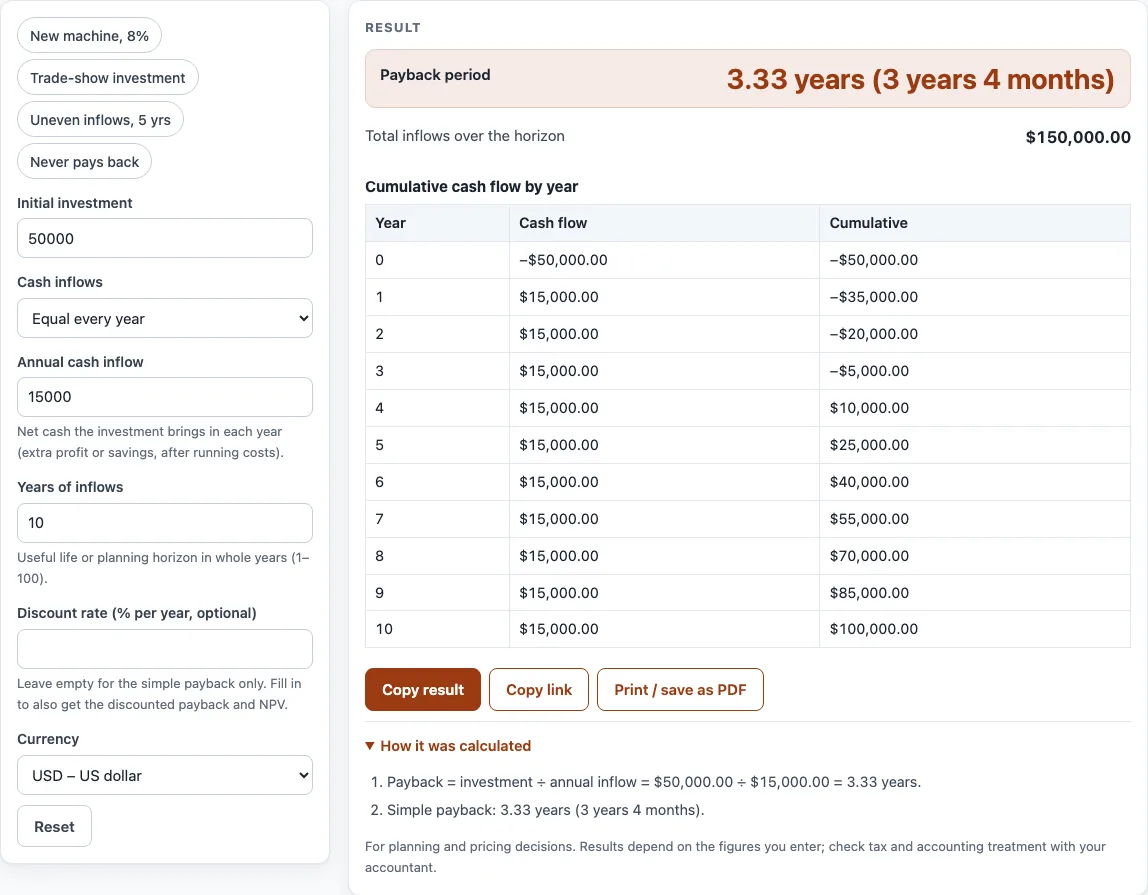
The Payback Period Calculator shows how many years it takes for an investment’s cash inflows to repay the money you put in. Enter the initial investment and the cash it brings in, and the payback period appears as you type. It works as a payback method calculator for quick checks on equipment, marketing, or any spending that should return cash over time. Add a discount rate and the tool also gives a discounted payback period and the NPV over the horizon. The tool runs in your browser, is free, and needs no sign-up. Nothing you type is uploaded.
It is a simple payback analysis calculator: the formula for calculating payback period is shown in the steps, so you can check the payback analysis formula against your own spreadsheet.
How to use the Payback Period Calculator
- Type the amount you spend in Initial investment.
- Under Cash inflows, choose Equal every year or Different each year.
- For equal inflows, type the net cash per year in Annual cash inflow. This is the extra profit or savings after running costs. Then enter the number of years in Years of inflows, as a whole number from 1 to 100.
- For different inflows, type each year’s amount in Yearly cash inflows, year 1 first. Put one number per line, or separate them with commas.
- Optional: type a yearly rate in Discount rate (% per year, optional). Leave it empty if you only want the simple payback.
- Pick your Currency from the list.
- Read the result lines: Payback period, Discounted payback period, NPV over the horizon, and Total inflows over the horizon. Check any warning shown beneath them.
The example buttons at the top of the form fill in a realistic case: “New machine, 8%”, “Trade-show investment”, “Uneven inflows, 5 yrs”, and “Never pays back”. The Reset button restores the starting example. Some fields are under More options.
Below the result, Copy result copies the figures, and Copy link copies a page address that keeps all your inputs, so opening it restores the same result. Print / save as PDF prints the inputs, the result, the calculation steps, and the date. The How it was calculated list shows the formula with your own numbers.
What is the payback formula for even cash flows?
The payback period is the time it takes for cash inflows to repay the initial investment. When the same amount arrives every year, the payback formula is investment ÷ annual cash inflow. For example, 50,000 ÷ 15,000 = 3.33 years, so the money comes back a little over three years after you spend it.
How do you calculate payback period when cash flows are uneven?
Add the inflows year by year until the running total turns positive. Then find the fraction of the last year: the amount still unrecovered at the start of that year, divided by that year’s inflow. This assumes cash arrives evenly within the year.
Take an investment of 20,000 with inflows of 6,000, 8,000, and 9,000. The running totals are 6,000, then 14,000, then 23,000. At the start of year 3, 6,000 is still unrecovered. Dividing 6,000 by 9,000 gives 0.67, so the payback period is 2.67 years.
Discounted payback uses the present value of each inflow, which is inflow ÷ (1 + r)^year, where r is the rate you typed in. When the rate is above zero, the discounted payback is always longer than the simple payback, because later cash is worth less today. The calculator never assumes a rate for you.
Payback has clear limits. It ignores cash flows that come after the payback year. The simple form also ignores the time value of money. Treat it as a quick risk check, and use NPV or IRR alongside it for the full picture. A shorter payback means your money is at risk for less time, which matters for small businesses and uncertain export markets.
Sources
- Payback period and discounted payback: OpenStax Principles of Accounting, Volume 2: Managerial Accounting (free textbook), capital budgeting.
- Every formula is worked through by hand in the tool’s tests (at least five reference cases per calculator).
Worked examples
| Input | Result |
|---|---|
| $50,000.00, $15,000.00 per year | 3.33 years (3 years 4 months) |
| $50,000.00, $15,000.00 per year | 3.33 years (3 years 4 months) |
| $80,000.00, uneven yearly inflows | 3.14 years (3 years 2 months) |
| €120,000.00, €9,000.00 per year | Does not pay back within 10 years |
| $15,000.00, uneven yearly inflows | 3.75 years (3 years 9 months) |
Calculated by the tool above with these values.
Frequently asked questions
What does a payback period of 3.33 years mean?
It means the cash inflows will have repaid the initial investment after about three years and four months. The 0.33 is a fraction of the fourth year, since 0.33 × 12 months is about four months.
What does “Never pays back” mean in the results?
It means the inflows you entered do not add up to the initial investment within the years you chose. The tool shows a warning with the total inflows over that period. Increase the years if the asset lasts longer, or check the inflow amounts.
Why is the discounted payback period longer than the simple payback?
Discounting reduces the value of each future inflow, so the cash takes longer to repay the investment in today’s terms. If you leave the discount rate empty, the discounted payback line does not apply.
Is a payback period over 10 years a problem?
A payback over 10 years is long. Risks and prices can change a lot over that time. The tool shows a warning in this case, but whether it matters depends on your own situation.
Can I use the results in a price list, quote, or business plan?
Yes. Results may be used in commercial work such as price lists, quotes, and business plans, with no attribution required.
Why is a negative discount rate flagged?
A negative rate makes later cash worth more than earlier cash, which is rarely what you want to model. The tool shows a warning so you can check the rate you typed.
Related tools
- IRR calculator — internal rate of return and NPV from cash flows.
- ROI calculator — return on investment and annualized ROI.
- Break even calculator — break-even units and sales with a chart.
- Contribution margin calculator — contribution per unit, in total and as a ratio.
- Profit margin calculator — profit, margin and markup from cost and price, or the price for a target margin.
- Cost per unit calculator — unit price, price per kg or litre, and the cheapest offer.