Net Margin Calculator (Net Profit Margin)
Enter revenue and costs to get net profit and the net margin, step by step down the income statement.
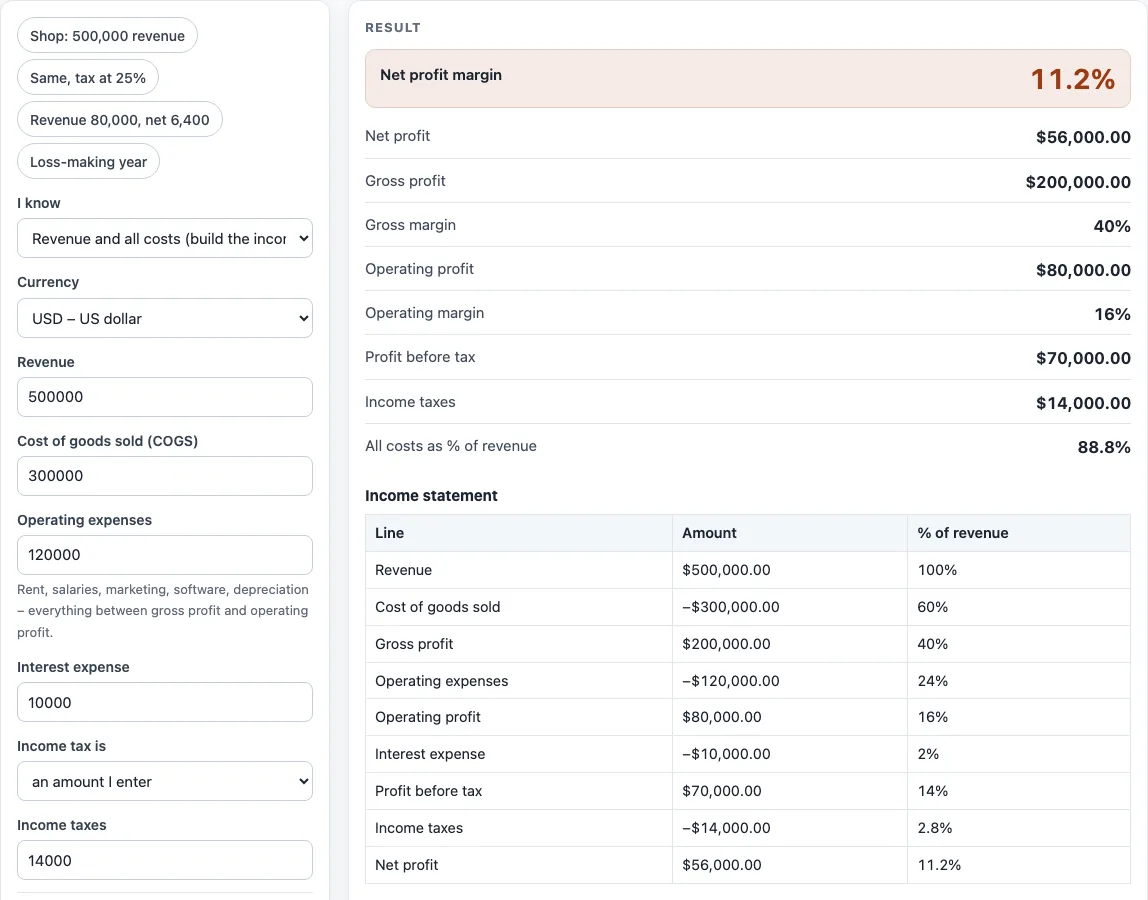
How to use the Net Margin Calculator
- Open the I know box and choose what you have: Revenue and all costs (build the income statement) or Revenue and net income.
- Choose your Currency from the list.
- Enter your Revenue.
- If you chose all costs, enter Cost of goods sold (COGS), Operating expenses and Interest expense. Then, under Income tax is, choose either an amount you enter or a rate on pre-tax profit, and fill in Income taxes or Tax rate %.
- If you chose net income, enter Net income (profit after tax). Use a negative number for a net loss.
- If needed, open More options to add Other income (optional) and Other expenses (optional).
- Read the Net profit margin result and check any warning messages.
The example buttons at the top of the form fill in a realistic case, so you can see how the fields fit together. Reset restores the starting example. Under the result, Copy result copies the figures, Copy link keeps all your inputs in the page address, and Print / save as PDF prints your inputs, result, calculation steps and the date.
You can switch between the two modes at any time; the result and the steps update straight away. Use Print / save as PDF to keep the small income statement with your figures and the date.
What is the net profit margin meaning?
Net profit margin shows how much of each unit of revenue you keep as profit after all costs. A margin of 11% means that for every 100 you earn, 11 is left after costs, interest and taxes. It is also called net profit percentage or net margin.
What is the formula for net margin?
Net profit margin = net profit (net income) ÷ revenue × 100. Divide the profit left after every cost by revenue, then multiply by 100 to get a percentage. Net profit is calculated as revenue minus COGS, operating expenses, interest and taxes, adjusted for any other income and expenses.
How is net profit calculated?
Work down the income statement one line at a time:
- Gross profit = revenue − COGS.
- Operating profit = gross profit − operating expenses.
- Profit before tax = operating profit − interest expense (plus other income, minus other expenses).
- Net profit = profit before tax − income taxes.
Rent, salaries, marketing, software and depreciation sit in operating expenses, so they are included before you reach operating profit.
What is the difference between gross and net margin?
Gross margin uses only COGS, so it shows how much is left after the direct cost of what you sell. Operating margin also subtracts operating expenses. Net margin subtracts everything, including interest and taxes, so it is always the lowest of the three for the same business.
How do you calculate operating margin?
Operating margin = operating profit ÷ revenue × 100. For example, if revenue is 500,000 and COGS is 300,000, gross profit is 200,000. Subtract operating expenses of 120,000 and operating profit is 80,000, giving an operating margin of 16%.
How do you calculate net income margin?
Use the same steps with net income in the top line. Take your profit after tax from the income statement, divide it by revenue, and multiply by 100. Continuing the example, interest of 10,000 and taxes of 15,000 reduce 80,000 to a net profit of 55,000. That gives a net margin of 11%, which is 55,000 ÷ 500,000 × 100.
Why can net margin be misleading when comparing businesses?
Net margin is affected by how a business is financed and how much tax it pays. Two businesses with the same operations can show different net margins because one has more debt. Comparing operating margins is often fairer in that case, because it stops before interest and tax.
What does a negative net margin mean?
A negative net margin means the business made a loss in that period. Costs were higher than revenue after all items were counted. The tool shows a warning when this happens, and the loss amount appears beside it.
What is the net profit margin ratio?
The net profit margin ratio is net profit ÷ revenue written as a decimal (0.11) instead of a percentage (11%). The formula for calculating net profit margin is the same either way; multiply the ratio by 100 to get the percentage.
Sources
- Income statement and net profit margin: OpenStax Principles of Accounting, Volume 1: Financial Accounting (free textbook).
- Every formula is worked through by hand in the tool’s tests (at least five reference cases per calculator).
Worked examples
| Input | Result |
|---|---|
| Revenue $500,000.00, COGS $300,000.00, operating expenses $120,000.00 (plus interest and tax) | Net profit $56,000.00, net margin 11.2% |
| Revenue $500,000.00, COGS $300,000.00, operating expenses $120,000.00 (plus interest and tax) | Net profit $52,500.00, net margin 10.5% |
| Revenue $1,200,000.00, COGS $700,000.00, operating expenses $350,000.00 (plus interest and tax) | Net profit $120,000.00, net margin 10% |
| Revenue $80,000.00, net income $6,400.00 | Net profit $6,400.00, net margin 8% |
| Revenue $100,000.00, COGS $70,000.00, operating expenses $40,000.00 (plus interest and tax) | Net profit −$10,000.00, net margin −10% |
Calculated by the tool above with these values.
Frequently asked questions
What is a good net profit margin?
It depends on the industry. Compare your margin with businesses that sell similar products or services, rather than with a single number.
Do I need to know my tax rate?
If you enter costs in the income statement, you need either a tax amount or your own effective rate. Check the current rate with your accountant. No tax is charged on a pre-tax loss.
What if I only know my revenue and net income?
Choose Revenue and net income in the I know box. You do not need to enter the individual costs.
Why does the tool warn that my net margin is unusually high?
Very high margins can mean that some costs are missing. Check that COGS, operating expenses, interest and taxes are all included.
Does the calculator save or upload my numbers?
No. The calculator runs in your browser, and nothing you type is uploaded.
Can I use the results in a business plan or price list?
Yes. You can use the results in commercial work, such as price lists, quotes and business plans, with no attribution required.
How do I share my result with someone?
Use Copy link. The page address keeps all your inputs, so opening it restores the same result.
Related tools
- Operating margin calculator — operating profit (EBIT), operating margin and EBITDA.
- Gross margin calculator — gross profit and gross margin from revenue and COGS.
- Profit margin calculator — profit, margin and markup from cost and price, or the price for a target margin.
- COGS calculator — cost of goods sold, gross margin and inventory turnover.
- ROI calculator — return on investment and annualized ROI.
- Break even calculator — break-even units and sales with a chart.