Late Payment Interest Calculator
Enter the invoice amount, due date and payment date to work out the interest and compensation you can claim.
This late payment interest calculator works out how much interest an overdue invoice has accrued, from the due date to the day it is paid. You can base the rate on your contract or on the UK statutory rate, and the result updates as you type. Many people search for a late payment calculator or a way to calculate interest on overdue invoices, and this page covers both, including UK business debts.
Everything runs in your browser, so nothing you type is uploaded. The tool is free and needs no sign-up. You enter the unpaid amount, the due date and the payment date, then choose how the rate is set. The result shows the days late, the interest per day, the interest owed and, for UK debts, the fixed compensation. Users searching for a late payment interest HMRC calculator will find the UK statutory rules explained below.
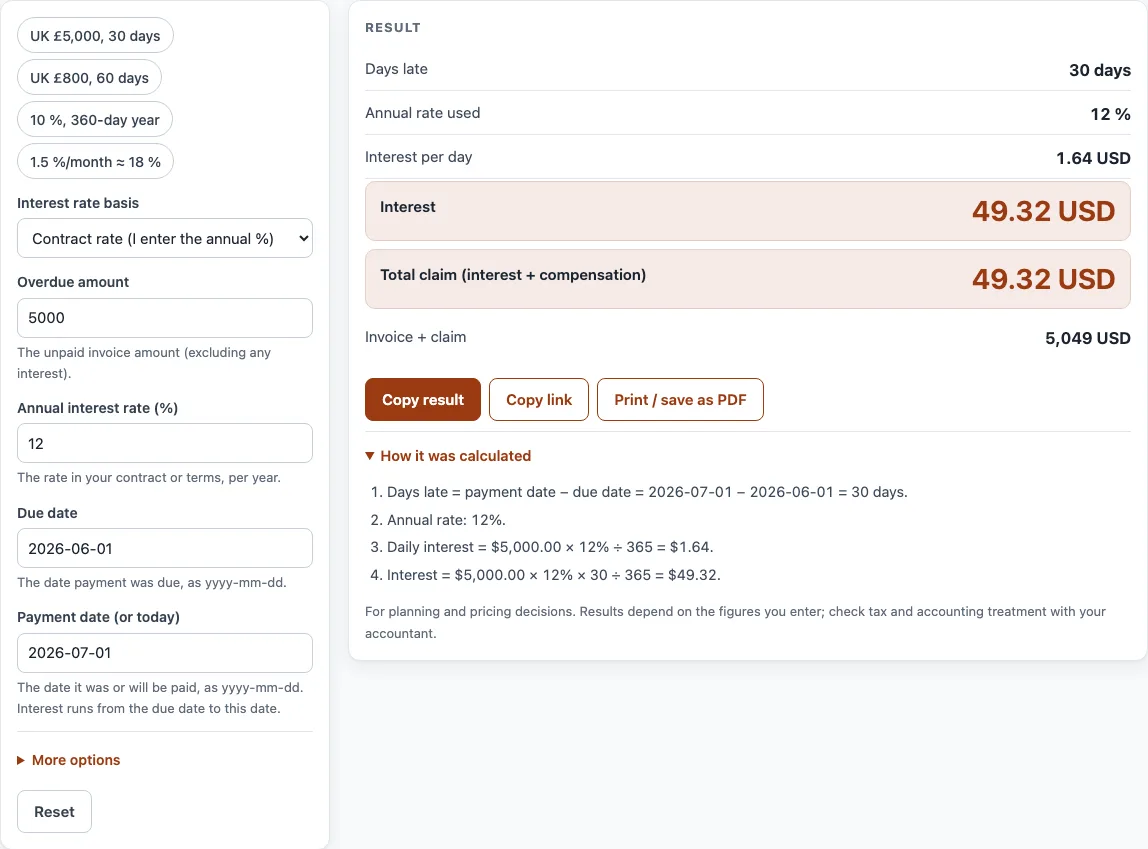
How to use the Late Payment Interest Calculator
- Try an example first. The buttons at the top, such as “UK £5,000, 30 days” or “1.5 %/month ≈ 18 %”, fill in a realistic case. Reset restores the starting example.
- Choose the Interest rate basis: Contract rate, or UK statutory (8 % + Bank of England rate).
- Enter the Overdue amount, excluding any interest.
- If you chose Contract rate, type the Annual interest rate (%) from your contract or terms. If you chose UK statutory, type the Bank of England base rate (%) that applies to your debt.
- Enter the Due date as yyyy-mm-dd.
- Enter the Payment date (or today) as yyyy-mm-dd. Interest runs from the due date to this date.
- Choose the Day-count basis: 365 days a year or 360 days a year.
- Choose the Currency. For the UK statutory scheme, select GBP.
- Read the result lines: Days late, Annual rate used, Interest per day, Interest, Fixed compensation (UK), Total claim (interest + compensation), and Invoice + claim.
- Open “How it was calculated” to see the formula with your own numbers.
Some fields sit under More options. The result updates as you type, so you can change one input and see the effect straight away.
Copy result copies the outcome. Copy link keeps all your inputs in the page address, so opening the link restores the same result. Print / save as PDF prints the inputs, the result, the calculation steps and the date.
How is late payment interest calculated?
Late payment interest is usually simple interest, charged per day. The formula is the amount × annual rate × days late ÷ 365. For example, 5,000 paid 30 days late at 13% a year gives 5,000 × 0.13 × 30 ÷ 365 = 53.42. If your contract uses a 360-day year, you divide by 360 instead.
Days late are counted from the day after the due date up to the payment date. If the invoice is paid on the due date, there are no days late and no interest. If the payment date is before the due date, the payment is not late and no interest is charged.
What is the UK statutory late payment rate?
For business-to-business debts in the UK, the statutory rate is 8% plus the Bank of England base rate, which is called the reference rate. The tool asks you to type that base rate yourself. It does not assume a rate, so look up the figure that applies to your debt.
The reference rate is the one in force on 30 June or 31 December just before the debt became late. For a debt that became late between 1 January and 30 June, use the base rate in force on the previous 31 December; for one that became late between 1 July and 31 December, use the rate in force on 30 June. Do not use today’s rate, because that is the most common mistake with this calculation.
As of 11 October 2026, the Bank of England Bank Rate history shows 3.75% since 18 December 2025, so the reference rate is 3.75% both for debts that became late from 1 January to 30 June 2026 (rate on 31 December 2025) and for those that become late from 1 July to 31 December 2026 (rate on 30 June 2026). That gives a statutory rate of 11.75%. The UK examples on this page use these figures.
Does a contract rate replace the statutory rate?
Statutory interest applies when the contract does not set its own late payment interest. If the contract does set a rate, that rate is used instead. A contract can set a different rate where it is a substantial remedy, so check the wording of your terms before choosing the basis.
What fixed compensation applies to UK late invoices?
On top of the interest, UK creditors can claim a fixed sum for each late invoice. It is £40 for debts under £1,000, £70 for debts from £1,000 to £9,999.99, and £100 for debts of £10,000 or more (section 5A of the 1998 Act, checked October 2026). You can also claim reasonable debt recovery costs above that amount. The tool adds the fixed compensation to the total claim.
How do late fees work outside the UK?
In the US there is no general federal rule for business late fees. The contract and state law limits decide the rate, and many invoices state a monthly charge such as 1.5% per month. A monthly rate can be converted to an annual rate by multiplying by 12, so 1.5% per month is about 18% a year. Choose the currency that matches the invoice, because the UK statutory scheme is set in pounds.
Sources
- Late Payment of Commercial Debts (Interest) Act 1998, including section 5A (fixed sums).
- Late Payment of Commercial Debts (Rate of Interest) (No. 3) Order 2002, article 4 — 8% over the Bank Rate on 30 June or 31 December.
- GOV.UK: charging interest on a commercial debt — daily interest = annual interest ÷ 365.
- Bank of England Bank Rate history — checked 11 October 2026.
Worked examples
| Input | Result |
|---|---|
| $5,000.00, 30 days late, 12% a year | interest $49.32, claim $49.32 |
| £5,000.00, 30 days late, 11.75% a year | interest £48.29, claim £118.29 |
| £800.00, 60 days late, 11.75% a year | interest £15.45, claim £55.45 |
| $10,000.00, 90 days late, 10% a year | interest $250.00, claim $250.00 |
| $2,500.00, 60 days late, 18% a year | interest $73.97, claim $73.97 |
Calculated by the tool above with these values.
Frequently asked questions
Can I use this as a late payment interest HMRC calculator?
Not for tax. HMRC charges its own late payment interest on unpaid tax, at a rate it publishes on GOV.UK; this calculator is for commercial invoices between businesses. You can still estimate simple interest on a tax debt by choosing a contract rate and typing HMRC’s published rate, but HMRC’s own statement is what counts.
Why does the result show zero days late?
The payment date is on or before the due date, so the invoice is not late. The tool shows “Paid on the due date: no days late” for an exact match. If the payment date is before the due date, the warning explains that no interest is charged.
Is the fixed compensation added to the interest?
Yes. Fixed compensation (UK) is shown separately, and the Total claim (interest + compensation) line adds it to the interest. Invoice + claim then adds the overdue amount to that total.
Why does the tool say an annual rate above 1,000 % looks wrong?
Rates that high are rarely correct for late payment interest, so the tool flags them as a likely typing error. Check that you entered a yearly percentage, not a monthly one. For a monthly rate, multiply by 12 first.
Does the day-count basis change the result much?
It does change the result a little. A 360-day year gives slightly more interest per day than a 365-day year for the same annual rate. Use the basis stated in your contract, and if none is stated, leave the default that matches your terms.
Related tools
- VAT calculator — add or remove VAT, one line or several rates.
- Discount calculator — percent off, sale price and stacked trade discounts.
- ROI calculator — return on investment and annualized ROI.
- Payback period calculator — simple and discounted payback in years.
- Profit margin calculator — profit, margin and markup from cost and price, or the price for a target margin.
- Sales commission calculator — flat and tiered commission plans plus base pay.