EBITDA Calculator (From Net Income or Operating Income)
Enter net income and add back interest, taxes, depreciation and amortization, or start from operating income, to get EBITDA, the EBITDA margin and the valuation multiples.
This EBITDA calculator works out earnings before interest, taxes, depreciation and amortization. You can start from net income and add back interest, income taxes, depreciation and amortization, or start from operating income (EBIT) and add back depreciation and amortization. It shows the EBIT on the way, and with a few more figures it adds the EBITDA margin, the EV/EBITDA multiple and net debt/EBITDA. It runs in your browser with no sign-up, and nothing you type is uploaded.
EBITDA is a way to compare the operating earnings of businesses with different debt, tax and depreciation. Lenders and buyers look at it, and so do owners who want to value their business or test how much debt it can carry. EBITDA is not an accounting standard figure, so state which method you used whenever you quote one.
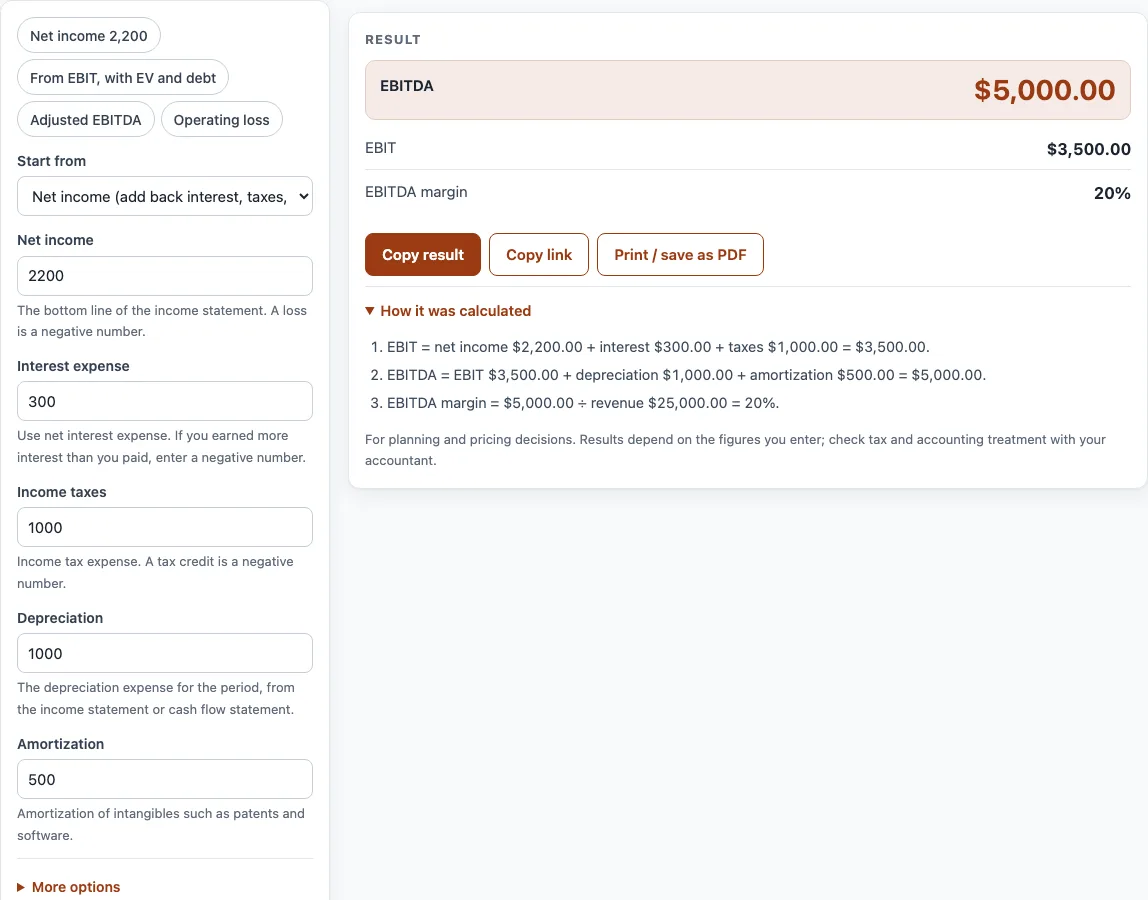
How to use the EBITDA Calculator
- Under Start from, choose Net income (add back interest, taxes, D&A) or Operating income (EBIT).
- For net income, type the Net income, the Interest expense and the Income taxes for the period. A loss, a net interest income and a tax credit are all negative numbers. For operating income, type the Operating income (EBIT).
- Type the Depreciation and the Amortization for the same period. Both come from the income statement or the cash flow statement.
- Optionally, under More options, add One-off items to add back (optional) to get Adjusted EBITDA, Revenue (optional) for the margin, Enterprise value (optional) for EV/EBITDA, Net debt (optional) for net debt/EBITDA, and set the Currency.
- Read EBITDA, EBIT and any of the optional results. How it was calculated gives each step with your numbers, and any warning appears above it. If you are unsure whether a figure is a cost or an income, read its help line under the box.
The four example buttons at the top of the form fill in a realistic case, and Reset restores the starting example. Below the result, Copy result copies the figures, Copy link keeps all your inputs in the page address so the same result reopens later, and Print / save as PDF prints the inputs, result, steps and date.
What is the EBITDA formula?
There are two common ways to the same figure.
EBITDA = net income + interest + taxes + depreciation + amortization
EBITDA = EBIT + depreciation + amortization
A worked example: a company has net income of 2,200, interest of 300, income taxes of 1,000, depreciation of 1,000 and amortization of 500. EBIT is 2,200 + 300 + 1,000 = 3,500, and EBITDA is 3,500 + 1,000 + 500 = 5,000. The second formula gives the same answer: 3,500 + 1,500 = 5,000. With revenue of 25,000, the EBITDA margin is 5,000 ÷ 25,000 = 20%.
The two methods agree when the operating income is the same as net income plus interest and taxes. If your operating income leaves out some non-operating gain or loss, or includes an item that the net-income route removes, the two results can differ, which is why the calculator offers both.
What is Adjusted EBITDA?
Adjusted EBITDA adds back one-off items such as restructuring costs or a one-time legal settlement, so the figure shows the earnings from normal trading. Enter those items under One-off items to add back (optional), as a positive number to add back a cost or a negative number to take out a one-off gain. The result is labelled Adjusted EBITDA, because a figure that differs from the standard definition should not be called plain EBITDA. How far a business adjusts its EBITDA is a judgement, and a buyer or a lender may disagree with it.
What do EV/EBITDA and net debt/EBITDA tell you?
EV/EBITDA divides the enterprise value, which is the market value of equity plus net debt, by EBITDA. It tells you how many years of EBITDA the market is paying for the business. If a company is valued at 50,000 and has EBITDA of 5,000, EV/EBITDA is 10x. Compare it with similar companies, not with a rule of thumb.
Net debt/EBITDA divides net debt, which is debt minus cash, by EBITDA. It is a common measure of how heavily a business is borrowed. With net debt of 12,500 and EBITDA of 5,000, it is 2.5x. Both ratios are shown only when EBITDA is above zero, because they mean little for a business with zero or negative EBITDA.
Is EBITDA the same as cash flow?
No. EBITDA ignores changes in working capital, spending on equipment, interest paid and tax paid, so a business can have a high EBITDA and still run short of cash. Use it to compare operating earnings, and use a cash flow statement to see cash.
Sources
- Wikipedia, Earnings before interest, taxes, depreciation, and amortization (checked October 2026) — the two formulas and the worked example 2,200 + 1,000 + 300 + 1,500 = 5,000, with EBIT 3,500; the SEC does not treat EBITDA as part of GAAP.
- Deloitte DART, Non-GAAP financial measures, SEC C&DI 103.02 (checked October 2026) — EBITDA as a performance measure is reconciled to net income, and a measure that differs from the standard definition should carry another name such as Adjusted EBITDA.
- Every formula is worked through by hand in the tool’s tests (at least five reference cases).
Worked examples
| Input | Result |
|---|---|
| net income $2,200.00, D&A $1,500.00 | EBITDA $5,000.00, 20% |
| EBIT $3,500.00, D&A $1,500.00 | EBITDA $5,000.00, 20% |
| net income $2,200.00, D&A $1,500.00 | EBITDA $5,000.00 |
| EBIT −€800.00, D&A €300.00 | EBITDA −€500.00, −5.56% |
Calculated by the tool above with these values.
Frequently asked questions
Is EBITDA the same as operating profit?
No. Operating profit (EBIT) is earnings before interest and taxes. EBITDA also adds back depreciation and amortization, so it is higher than EBIT for any business that has them. The operating margin calculator shows both from revenue and costs.
Which method should I use?
Use net income when you have the full income statement, because the SEC guidance reconciles EBITDA to net income. Use operating income when that is the figure you have. For most businesses they agree.
Can EBITDA be negative?
Yes. A negative EBITDA means the business loses money from its operations even before depreciation and amortization. The calculator warns you and leaves out the multiples.
What is a good EBITDA margin?
It depends on the industry. Software and services businesses usually have a higher margin than shops and manufacturers, so compare with similar businesses and with your own past figures.
Why is interest negative in my example?
A negative interest figure means you earned more interest than you paid, so net interest was income. The formula takes it off net income to reach EBIT, which the calculator does for you.
Is my information sent to a server?
No. Everything runs in your browser and nothing you type is uploaded. Nothing is stored on a server.
Related tools
- Operating margin calculator — operating profit (EBIT), operating margin and EBITDA.
- Net margin calculator — net profit and net profit margin after all costs.
- Gross margin calculator — gross profit and gross margin from revenue and COGS.
- Profit margin calculator — profit, margin and markup from cost and price, or the price for a target margin.
- WACC calculator — weighted average cost of capital, with CAPM for the cost of equity.
- ROI calculator — return on investment and annualized ROI.