Contribution Margin Calculator
Enter price and variable cost per unit, or total sales and variable costs, to get the contribution margin and ratio.
Contribution margin is the money left from sales after you subtract variable costs. The Contribution Margin Calculator works this out for you. Enter a price and variable cost per unit, or total sales and total variable costs, and it returns the contribution margin per unit, the total contribution margin, and the contribution margin ratio. Add fixed costs and it also shows operating income and the break-even point. The tool runs in your browser, is free, and needs no sign-up. Nothing you type is uploaded.
Use it to compute contribution margin for a product before you set a price, or to check whether a large export order still covers its share of your fixed costs.
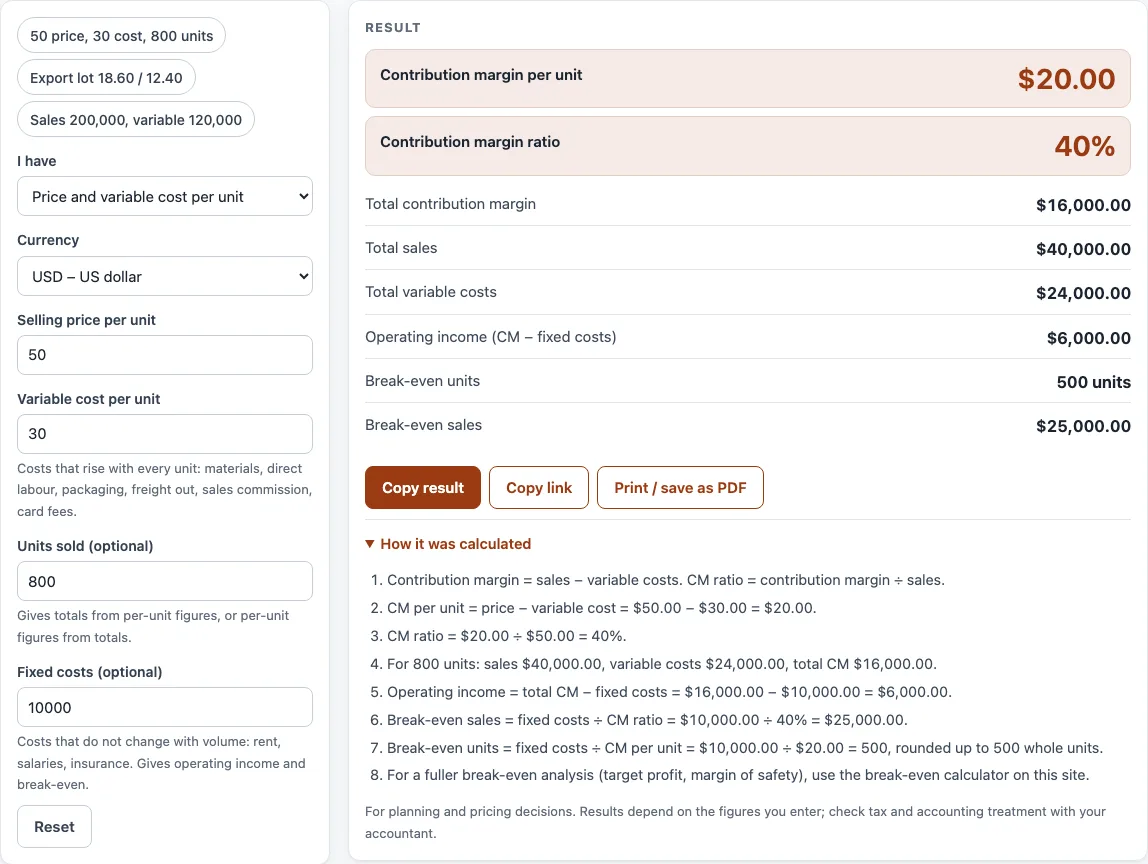
How to use the Contribution Margin Calculator
- Under I have, choose Price and variable cost per unit or Total sales and total variable costs.
- Open Currency and pick yours from the list, such as USD or EUR.
- If you chose per-unit figures, type your Selling price per unit and Variable cost per unit. The help text under the variable cost field lists typical examples: materials, direct labour, packaging, freight out, sales commission and card fees.
- If you chose totals, type Total sales and Total variable costs instead.
- Optional: under More options, enter Units sold to convert per-unit figures into totals, or totals into per-unit figures. Enter Fixed costs to see operating income and break-even.
- Read the result lines. Contribution margin per unit and Contribution margin ratio show your core answers. If a warning appears, read it before you use the numbers.
- Open How it was calculated to see the formula and each step with your own figures.
The example buttons at the top of the form fill in a sample case, such as “50 price, 30 cost, 800 units”. The result updates as you type, and the Reset button restores the starting example.
Under the result, Copy result copies the figures for a quote or report. Copy link keeps all your inputs in the page address, so opening the link restores the same result. Print / save as PDF prints the inputs, the result, the calculation steps and the date.
What is contribution margin?
Contribution margin is the money left from sales after you pay the variable costs of making and selling those units. It is the amount available to cover fixed costs and then leave a profit. Variable costs are the ones that rise with each unit sold, such as materials, packaging and sales commission.
What is the contribution margin formula?
The basic formula is contribution margin = sales − variable costs. For a single unit, use contribution margin per unit = price − variable cost per unit. With a price of 50 and a variable cost of 30, the contribution margin per unit is 20. Across 1,000 units, the total contribution margin is 20,000.
How do you calculate contribution margin per unit?
Subtract the variable cost per unit from the selling price per unit. A price of 50 minus a variable cost of 30 gives 20 per unit. To get the total, multiply by the number of units sold: 20 × 1,000 = 20,000. Keep every figure in the same currency and for the same unit of sale.
What is the contribution margin ratio formula?
Contribution margin ratio = contribution margin ÷ sales × 100. It shows the percentage of each sale that remains after variable costs. With a contribution margin of 20 on a price of 50, the ratio is 20 ÷ 50 × 100 = 40%. In other words, 40 cents of every dollar of sales is left to cover fixed costs and profit.
How do fixed costs and break-even fit in?
Fixed costs do not change with volume in the short run. Examples are rent, salaries and insurance. They are paid from the contribution margin, so operating income = total contribution margin − fixed costs. With fixed costs of 12,000 and 1,000 units at 20 each, operating income is 8,000.
Break-even units = fixed costs ÷ contribution margin per unit, so 12,000 ÷ 20 = 600 units. Break-even sales = fixed costs ÷ contribution margin ratio, so 12,000 ÷ 0.40 = 30,000.
How is contribution margin different from gross margin?
Gross margin subtracts cost of goods sold (COGS), which can include fixed production overhead. Contribution margin subtracts all variable costs, including variable selling costs such as sales commission. Because the cost lists differ, the two figures can be quite different for the same product.
What do the warnings mean?
If the variable cost is higher than the price, every sale loses money before fixed costs are counted. If the contribution margin is zero, each sale only covers its own variable cost. If it is not positive, sales never cover fixed costs, so there is no break-even point at that price and variable cost. An operating loss means the contribution margin does not cover the fixed costs.
Sources
- Contribution margin and contribution margin ratio: OpenStax Principles of Accounting, Volume 2: Managerial Accounting (free textbook), cost-volume-profit analysis.
- Every formula is worked through by hand in the tool’s tests (at least five reference cases per calculator).
Worked examples
| Input | Result |
|---|---|
| Price $50.00, variable cost $30.00 per unit | CM $20.00 per unit, ratio 40%, break-even 500 units |
| Price $50.00, variable cost $30.00 per unit | CM $20.00 per unit, ratio 40% |
| Sales $200,000.00, variable costs $120,000.00 | Total CM $80,000.00, ratio 40%, break-even sales $125,000.00 |
| Sales $200,000.00, variable costs $120,000.00 | CM $16.00 per unit, ratio 40% |
| Price $18.60, variable cost $12.40 per unit | CM $6.20 per unit, ratio 33.33% |
Calculated by the tool above with these values.
Frequently asked questions
Is contribution margin the same as profit?
No. Contribution margin is measured before fixed costs such as rent and salaries are paid. Profit is what remains after those costs are covered too.
What is a good contribution margin ratio?
The tool does not compare your ratio with industry figures. Judge it against your own fixed costs: the higher the ratio, the more of each sale is available to cover them.
Can contribution margin be negative?
Yes. If the variable cost per unit is higher than the price, each sale loses money before fixed costs, and the tool shows a warning.
Do I need units sold to calculate contribution margin?
Not for the per-unit figures. You need units sold, or total sales, to get the total contribution margin and the break-even results.
Which currencies does the calculator support?
It offers 24 currencies, from USD and EUR to THB. Choose the one that matches your prices and costs.
Does the tool upload or store what I type?
No. Everything runs in your browser, and nothing you type is uploaded.
Can I use the results in a quote or business plan?
Yes. Results may be used in commercial work, such as price lists, quotes and business plans, with no attribution required.
Related tools
- Break even calculator — break-even units and sales with a chart.
- Profit margin calculator — profit, margin and markup from cost and price, or the price for a target margin.
- Gross margin calculator — gross profit and gross margin from revenue and COGS.
- Cost per unit calculator — unit price, price per kg or litre, and the cheapest offer.
- Markup calculator — the price from cost and markup, or the markup between cost and price.
- Payback period calculator — simple and discounted payback in years.