COGS Calculator (Cost of Goods Sold)
Enter your inventory and purchases to get the cost of goods sold, gross profit and inventory turnover.
The COGS calculator works out cost of goods sold (COGS): the direct cost of the products a business sold during a period. Enter your beginning inventory, purchases and ending inventory, or enter units sold and a cost per unit, and the result updates as you type. Add optional figures to also see gross profit, gross margin, inventory turnover and days in inventory.
Everything runs in your browser, so nothing you type is uploaded. The tool is free and needs no sign-up. You can use the results in price lists, quotes and business plans without attribution.
It is a quick way to compute COGS for a period, check the cost of goods sold equation by hand, and see how fast your stock turns.
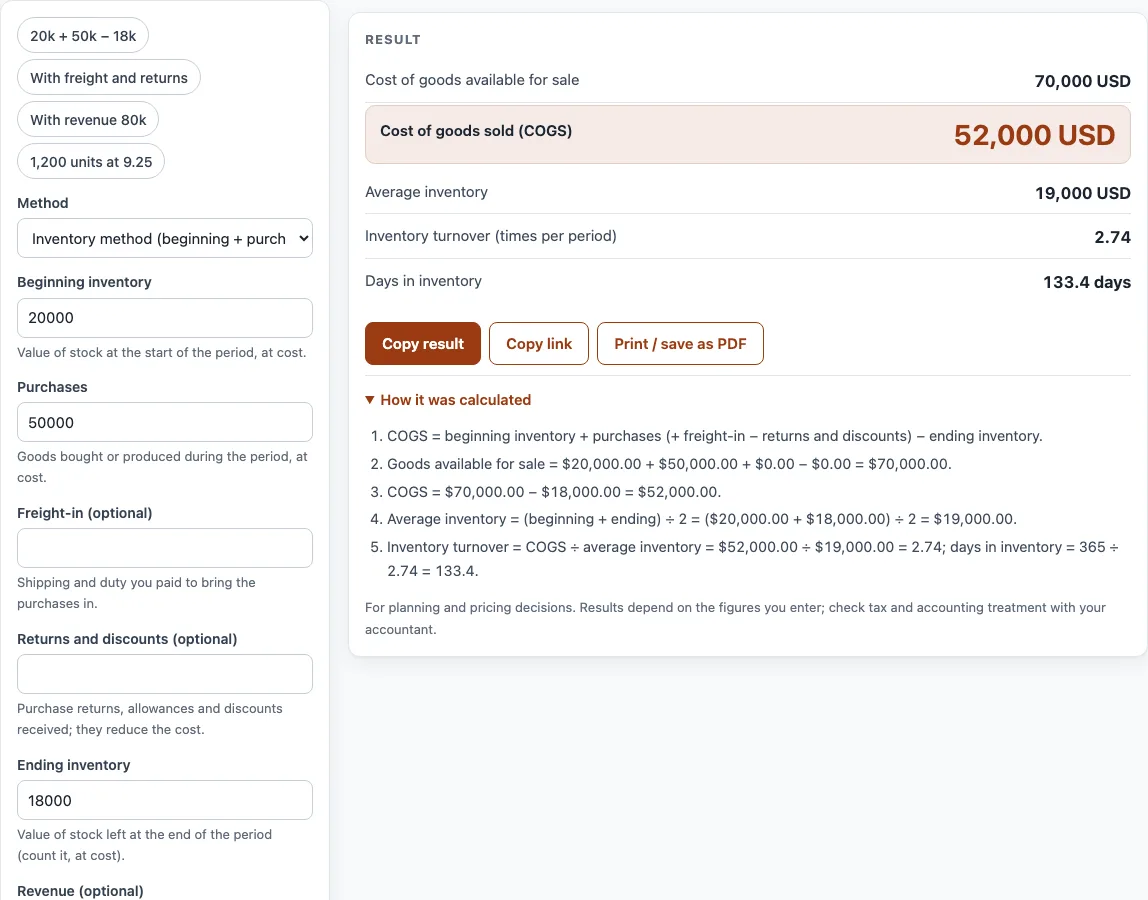
How to use the COGS calculator
- Choose a Method. Pick Inventory method if you know your stock at the start and end of the period and what you bought. Pick Per unit if you know how many units you sold and what each one cost.
- For the inventory method, enter Beginning inventory: the value of stock at the start of the period, at cost.
- Enter Purchases: goods bought or produced during the period, at cost.
- If they apply, enter Freight-in (optional) for shipping and duty you paid to bring purchases in, and Returns and discounts (optional) for purchase returns, allowances and discounts received.
- Enter Ending inventory: the value of stock left at the end of the period, counted at cost.
- For the per-unit method, enter Units sold and Cost per unit. If each unit also carries freight, duty, insurance or handling, add that amount in Extra landed cost per unit (optional).
- Read the Cost of goods sold (COGS) line. To see more, enter Revenue (optional) for gross profit and gross margin, or Average inventory (optional) and Days in the period for turnover and days in inventory.
- Open How it was calculated to see the formula with your own numbers.
Example buttons at the top of the form fill in a realistic case, such as “20k + 50k − 18k” or “1,200 units at 9.25”.
What is the cost of goods sold meaning in accounting?
What does cost of goods sold mean in practice? It is the cost side of every sale.
Cost of goods sold is the cost of the goods a business actually sold in a period, not the cost of everything it bought. Stock that is still unsold stays on the balance sheet as inventory until it is sold.
What is the cost of goods sold formula?
Under the periodic method, COGS = beginning inventory + purchases (+ freight-in − purchase returns and discounts) − ending inventory. The formula starts with the stock you had and added to during the period, then removes what is still on hand at the end. For example, 20,000 + 50,000 − 18,000 = 52,000.
How do you calculate COGS with the per-unit method?
Multiply the units sold by the cost per unit. If each unit carries landed costs such as freight, duty or insurance, include them in the unit cost. For 1,200 units at 9.25, COGS is 1,200 × 9.25 = 11,100.
How does COGS lead to gross profit and gross margin?
COGS is subtracted from revenue to give gross profit. Gross margin is gross profit divided by revenue. With revenue of 80,000 and COGS of 52,000, gross profit is 28,000 and gross margin is 35%.
Does COGS include operating expenses?
No. COGS covers the cost of the goods themselves. Operating expenses such as office rent, marketing and admin salaries are not part of COGS and are subtracted separately on the income statement.
How does the inventory costing method change COGS?
The costing method decides which unit costs are assigned to goods sold. The main methods are FIFO and weighted average, and LIFO is allowed under US GAAP but not IFRS. When purchase prices change, the method you use changes COGS even if the stock count stays the same.
How are inventory turnover and days in inventory worked out?
Average inventory is (beginning + ending) ÷ 2. Inventory turnover is COGS ÷ average inventory, and days in inventory is the days in the period ÷ turnover. Using the example above, average inventory is 19,000, turnover is 52,000 ÷ 19,000 = 2.74 times, and days in inventory is 365 ÷ 2.74 = 133 days.
What is the COGS formula for manufacturing?
For a manufacturer, the COGS formula uses finished goods: beginning finished goods inventory + cost of goods manufactured (materials used, direct labour and production overhead) − ending finished goods inventory. To determine cost of goods sold with this calculator, enter the cost of goods manufactured in the Purchases field. Figuring out cost of goods sold this way keeps selling and admin costs out of it.
Sources
- COGS = beginning inventory + purchases − ending inventory, inventory turnover and days in inventory: OpenStax Principles of Accounting, Volume 1: Financial Accounting (free textbook), inventory chapter.
- LIFO is prohibited under IFRS: IAS 2 Inventories; it remains allowed under US GAAP (ASC 330).
- Every formula is worked through by hand in the tool’s tests (at least five reference cases per calculator).
Worked examples
| Input | Result |
|---|---|
| Begin $20,000.00, purchases $50,000.00, end $18,000.00 | COGS $52,000.00 |
| Begin $20,000.00, purchases $50,000.00, end $18,000.00 | COGS $53,000.00 |
| 1200 units at $9.25 each | COGS $11,100.00 |
| Begin $20,000.00, purchases $50,000.00, end $18,000.00 | COGS $52,000.00 |
| 1200 units at £9.25 each | COGS £11,100.00 |
Calculated by the tool above with these values.
Frequently asked questions
What is the cost of goods sold formula?
Use beginning inventory + purchases − ending inventory. Add freight-in, and subtract purchase returns and discounts, if they apply to your business.
How do you find cost of goods sold for a business that makes its own products?
Enter the goods produced in the period, at cost, in the Purchases field. The rest of the inventory method stays the same.
Is COGS the same as total expenses?
No. COGS covers only the cost of goods sold. Rent, marketing and admin costs are operating expenses and are not included.
What if I leave out freight-in?
COGS will be lower than the true cost of the goods, because shipping and duty you paid to bring them in are part of their cost.
Why does the tool show that COGS is zero?
If COGS is zero, turnover and days in inventory cannot be worked out, because both divide by COGS. Check that your inputs are correct.
Why did I get an error about ending inventory?
The ending inventory is more than the goods available for sale. Check the beginning inventory, purchases and ending inventory figures.
Can I use the COGS figure in a business plan?
Yes. Results may be used in commercial work, such as price lists, quotes and business plans, with no attribution.
Related tools
- Gross margin calculator — gross profit and gross margin from revenue and COGS.
- Profit margin calculator — profit, margin and markup from cost and price, or the price for a target margin.
- Net margin calculator — net profit and net profit margin after all costs.
- Cost per unit calculator — unit price, price per kg or litre, and the cheapest offer.
- Operating margin calculator — operating profit (EBIT), operating margin and EBITDA.
- Markup calculator — the price from cost and markup, or the markup between cost and price.