Break Even Calculator (Break-Even Point)
Enter fixed costs, price and variable cost per unit to see how many units you must sell to break even.
The break-even point is the sales volume at which total revenue equals total costs, so profit is exactly zero. This Break-Even Calculator finds it for you: enter your fixed costs, selling price per unit and variable cost per unit, and the result shows the break-even point in units and in sales. It is free, needs no sign-up, and runs in your browser. Nothing you type is uploaded.
The result updates as you type, so you can test a lower price or higher costs and see how the break-even point moves. You can also add a target profit or an expected sales volume to see how many units you need for that profit and how much room your forecast leaves above break-even. Results can be used in price lists, quotes and business plans.
How to use the Break-Even Calculator
- Enter Fixed costs (total): the costs that do not change with volume in the period, such as rent, salaries, insurance, loan payments and software.
- Enter Selling price per unit.
- Enter Variable cost per unit: materials, packaging, freight, payment fees and sales commission for one unit.
- Optional: enter Target profit (optional), the profit you want on top of covering the fixed costs.
- Optional: enter Expected units sold (optional), your forecast for the same period.
- Pick a Currency from the list, such as USD, EUR or GBP.
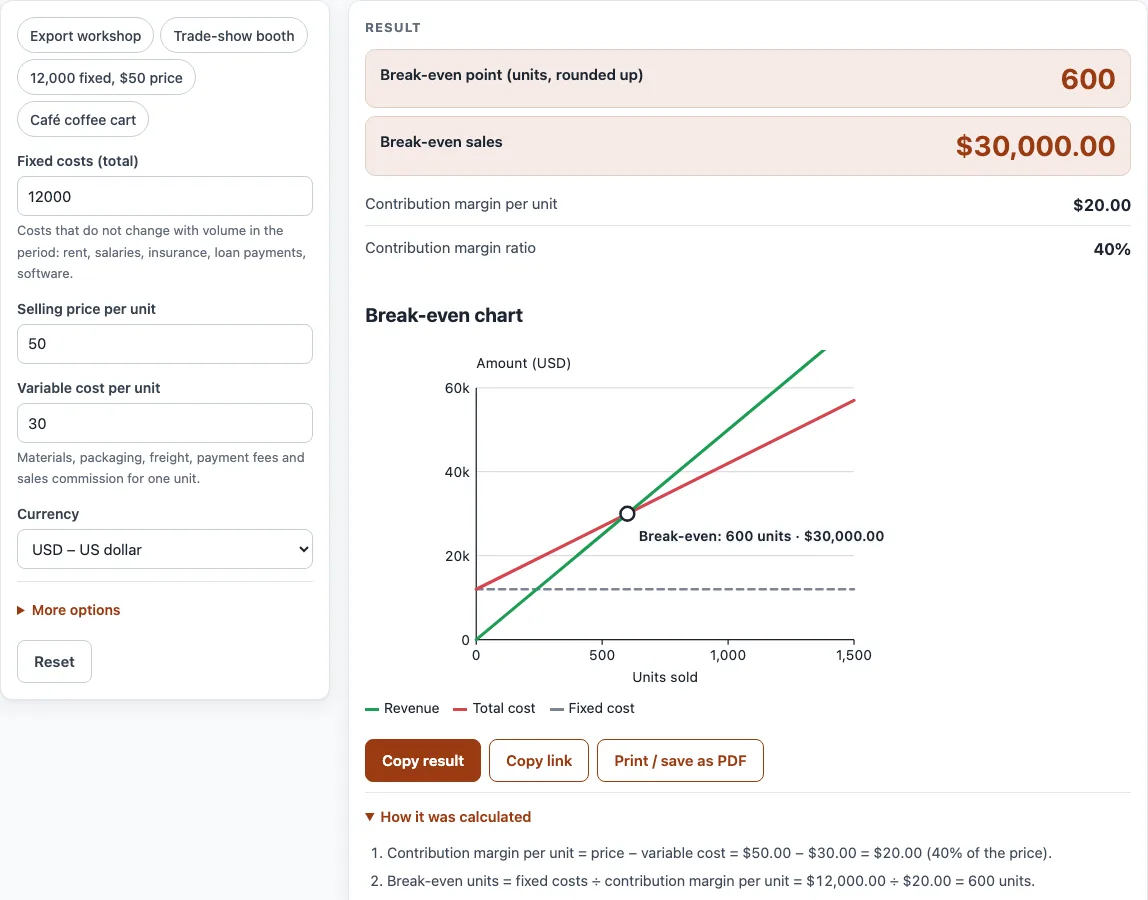
- Read the results: Break-even point (units, rounded up), Break-even point (exact units), Break-even sales and the contribution margin lines. If you filled in the optional fields, you will also see the target profit, margin of safety and profit at expected units.
- Check the Break-even chart, where the Revenue line crosses the Total cost line.
Example buttons at the top of the form fill in a realistic case: Export workshop, Trade-show booth, 12,000 fixed and $50 price, or Café coffee cart. The Reset button restores the starting example, and some fields are under More options. Below the result, Copy result copies the figures, Copy link keeps all your inputs in the page address, and Print / save as PDF prints the inputs, result, calculation steps and date.
Break even point explained: what is its meaning?
The break-even point is the sales level at which total revenue equals total costs, so profit is zero. Below it the business makes a loss for the period; above it, each extra sale adds profit. On a chart, it is where the revenue line crosses the total cost line.
What is the break even point formula in units?
Break-even point in units = fixed costs ÷ (price per unit − variable cost per unit). The part in brackets is the contribution margin per unit: what each sale contributes toward fixed costs after paying its own variable cost. With fixed costs of 12,000, a price of 50 and a variable cost of 30, the contribution margin is 20, so 12,000 ÷ 20 = 600 units.
Break-even units are rounded up to a whole unit, because you cannot sell part of a unit. If the result were 600.4, you would need 601 units to break even. The calculator shows the rounded-up figure and the exact figure.
How do you calculate break-even sales?
Break-even sales = break-even units × price per unit, or fixed costs ÷ contribution margin ratio. In the example, 600 × 50 = 30,000, and 12,000 ÷ 0.4 = 30,000. The contribution margin ratio is the contribution margin per unit divided by the price: 20 ÷ 50 = 0.4, which means 40 cents of each sale goes toward fixed costs. Both routes give the same answer.
How do you calculate units for a target profit?
Units for a target profit = (fixed costs + target profit) ÷ contribution margin per unit. The target profit is the profit you want on top of covering fixed costs. With a target profit of 8,000, the calculation is (12,000 + 8,000) ÷ 20 = 1,000 units. The calculator also shows the sales for that target profit. If the target profit is zero, only the break-even point is shown.
What is the margin of safety formula?
Margin of safety = expected sales − break-even sales, and the percentage is that margin divided by expected sales. Take an expected 900 units against 600 break-even units: the margin is 300 units, or 300 ÷ 900 = 33.33%. Sales could fall by about a third before the business starts to lose money. If your expected units are below break-even, the calculator warns you of the loss at that volume.
What is the break even analysis definition?
Break-even analysis is the study of how fixed costs, selling price and variable costs together decide the sales volume needed to cover all costs. It shows how much you must sell before a product pays for itself and how each change in price or cost shifts that volume. The chart shows the same idea visually, with Units sold on the horizontal axis and the Revenue, Total cost, Fixed cost and Expected lines plotted against it.
What is the formula for calculating break even, and how is determining the break even point useful?
The formula for calculating break even in units is fixed costs ÷ contribution margin per unit, and in sales it is fixed costs ÷ contribution margin ratio. Determining the break even point before you launch a product, take a booth at a trade show or quote a new export market tells you the minimum volume that makes the plan worth it.
Sources
- Break-even point in units and sales: OpenStax Principles of Accounting, Volume 2: Managerial Accounting (free textbook), cost-volume-profit analysis.
- Every formula is worked through by hand in the tool’s tests (at least five reference cases per calculator).
Worked examples
| Input | Result |
|---|---|
| Fixed costs $12,000.00, price $50.00, variable cost $30.00 | Break-even at 600 units ($30,000.00 of sales) |
| Fixed costs $12,000.00, price $50.00, variable cost $30.00 | Break-even at 600 units ($30,000.00 of sales) |
| Fixed costs €8,500.00, price €24.90, variable cost €11.40 | Break-even at 630 units (€15,677.78 of sales) |
| Fixed costs $45,000.00, price $129.00, variable cost $71.00 | Break-even at 776 units ($100,086.21 of sales) |
| Fixed costs £2,400.00, price £9.50, variable cost £4.10 | Break-even at 445 units (£4,222.22 of sales) |
Calculated by the tool above with these values.
Frequently asked questions
Why is my break-even point rounded up?
You cannot sell part of a unit, so the calculator rounds the break-even units up to the next whole number. The exact figure is still shown on its own result line.
What happens if my price is lower than the variable cost?
The calculator shows an error: the selling price must be higher than the variable cost per unit. Each sale would lose money, so the business never breaks even.
What if I have no fixed costs?
With no fixed costs, every sale already makes a profit, so the break-even point is zero units.
What counts as a fixed cost?
A fixed cost is one that does not change with volume during the period. Examples include rent, salaries, insurance, loan payments and software.
Can I use this calculator for social security benefits?
This tool works only with fixed costs, a selling price per unit and a variable cost per unit. It has no inputs for benefit amounts, so it is not built for social security break-even questions.
Does the calculator add tax or interest?
No. The calculator does not assume any tax or interest rate, so none is added to your results.
Can I use the results in a business plan?
Yes. Results may be used in commercial work such as price lists, quotes and business plans, with no attribution required.
Related tools
- Contribution margin calculator — contribution per unit, in total and as a ratio.
- Payback period calculator — simple and discounted payback in years.
- ROI calculator — return on investment and annualized ROI.
- Profit margin calculator — profit, margin and markup from cost and price, or the price for a target margin.
- Cost per unit calculator — unit price, price per kg or litre, and the cheapest offer.
- IRR calculator — internal rate of return and NPV from cash flows.