Accounting Rate of Return Calculator and Formula (ARR)
Enter the investment, residual value, life and yearly profit to get the accounting rate of return and compare it with your required rate.
The accounting rate of return formula is ARR = average annual accounting profit ÷ investment base. This free calculator applies that formula for you. Enter the cost, residual value, useful life and either the yearly profit or the yearly cash inflows, and it shows the ARR as a percentage with a decision against your required rate of return. It runs in your browser with no sign-up, and nothing you type is uploaded.
ARR is also called the average rate of return. It measures how much profit an investment earns each year as a share of the money put into it, which is why businesses use it to compare capital projects. The result updates as you type, so you can test different figures quickly.
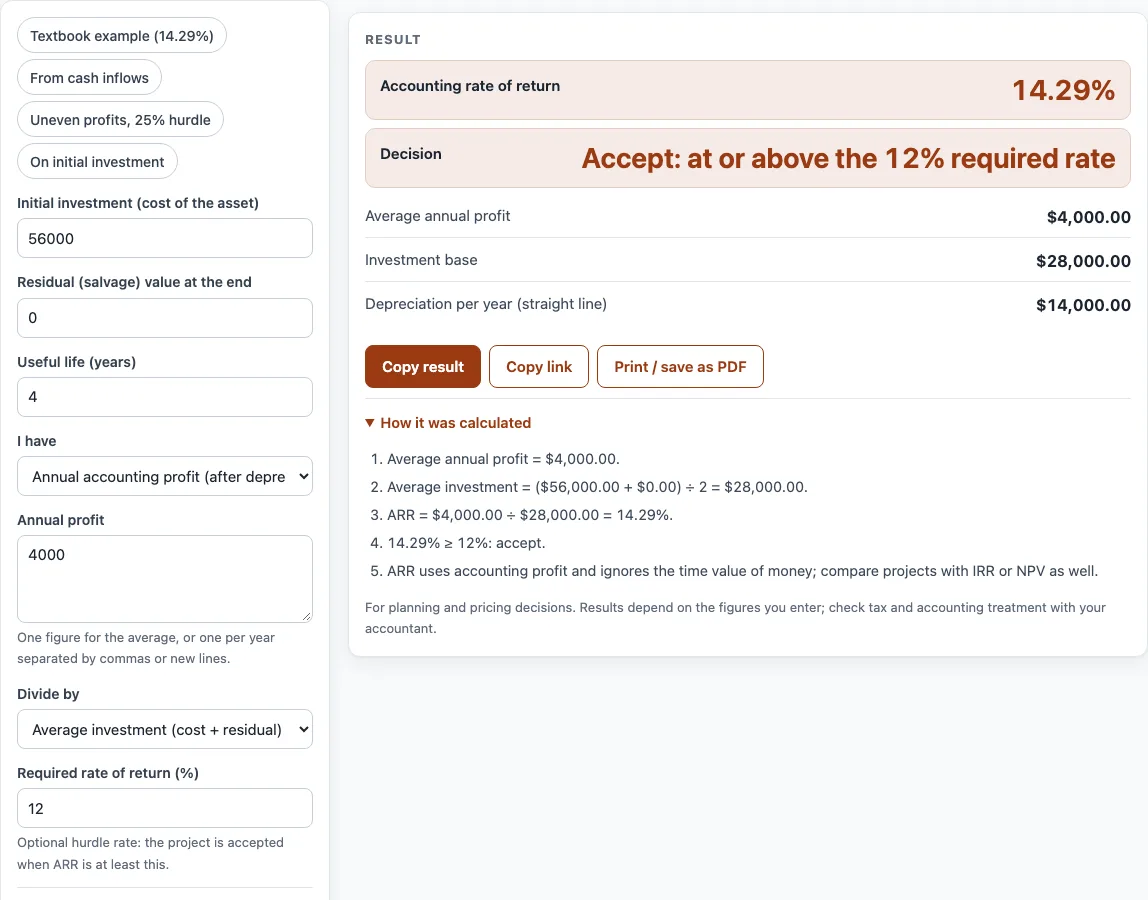
How to use the Accounting Rate of Return Calculator
- Type the cost of the asset in Initial investment (cost of the asset).
- Type the value the asset will have at the end in Residual (salvage) value at the end.
- Type the number of years in Useful life (years).
- Under I have, choose either Annual accounting profit (after depreciation) or Annual cash inflows (depreciation is taken off).
- Type your figures into Annual profit or Annual net cash inflows. Enter one figure for the average, or one figure per year separated by commas or new lines.
- Under Divide by, choose Average investment (cost + residual) ÷ 2 or Initial investment.
- Optionally, enter a Required rate of return (%). The decision line shows whether the ARR meets it.
- Under More options, set the Currency shown with the figures.
- Read the Accounting rate of return, Decision and calculation lines, and check How it was calculated for each step.
The four example buttons at the top of the form fill in a realistic case, and Reset restores the starting example. Below the result, Copy result copies the figures, Copy link keeps all your inputs in the page address so the same result reopens later, and Print / save as PDF prints the inputs, result, steps and date.
What is the accounting rate of return formula?
The formula divides the average yearly accounting profit by the investment base:
ARR = average annual accounting profit ÷ investment base
Profit here means profit after depreciation, as shown in the profit and loss account, not cash received. If you start from cash inflows, first subtract depreciation from each year’s cash inflow to get the profit. Straight-line depreciation is (cost − residual value) ÷ useful life.
Take an asset costing $56,000 with no residual value, which produces cash inflows of $18,000 a year over 4 years. Depreciation is $56,000 ÷ 4 = $14,000 a year, so the profit is $18,000 − $14,000 = $4,000. The average investment is $28,000, so ARR = 4,000 ÷ 28,000 = 14.29%. Using the profit figure directly gives the same answer.
How is the investment base found for ARR?
Most textbooks use the average investment, which is (initial cost + residual value) ÷ 2. This is the investment base the calculator uses by default. Some courses use the initial investment instead, which gives a lower ARR because the denominator is larger.
Take a project costing $120,000 with a $20,000 residual value over 5 years, and profits of 15,000, 18,000, 21,000, 19,000 and 17,000. The average profit is $18,000 and the average investment is ($120,000 + $20,000) ÷ 2 = $70,000, so ARR = 25.71%. Dividing by the initial $120,000 instead gives 15%. Check which base your course or business uses before comparing results.
A project is accepted when its ARR is at least the required (hurdle) rate the business sets. If the average profit is negative, the project loses money on these figures, and the ARR will be negative.
ARR is simple and uses figures the business already records. Its main weaknesses are that it ignores the time value of money and the timing of profits, and that its result depends on the depreciation method. For that reason, many analysts also calculate NPV or IRR. ARR is not the same as ROI (return on investment), which divides the total net gain by the amount invested, and it is not the same as IRR, which is the discount rate at which NPV is zero.
Sources
- Lumen Learning, Managerial Accounting: accounting rate of return (open textbook) — ARR = average annual profit ÷ average investment; worked example $56,000 asset, $4,000 average profit, 14.29 %.
- Every formula is worked through by hand in the tool’s tests (at least five reference cases).
Worked examples
| Input | Result |
|---|---|
| $56,000.00, 4 years, on average investment (cost + residual) ÷ 2 | ARR 14.29% (profit $4,000.00 on $28,000.00) — Accept: at or above the 12% required rate |
| $56,000.00, 4 years, on average investment (cost + residual) ÷ 2 | ARR 14.29% (profit $4,000.00 on $28,000.00) — Accept: at or above the 12% required rate |
| $120,000.00, 5 years, on average investment (cost + residual) ÷ 2 | ARR 25.71% (profit $18,000.00 on $70,000.00) — Accept: at or above the 25% required rate |
| $120,000.00, 5 years, on initial investment | ARR 15% (profit $18,000.00 on $120,000.00) |
Calculated by the tool above with these values.
Frequently asked questions
Is the average rate of return the same as ARR?
Yes. The average rate of return and the accounting rate of return are two names for the same measure. Both use average annual profit divided by an investment base.
Why does the Divide by option change the result?
The option sets the denominator. Dividing by the average investment gives a higher percentage than dividing by the initial investment, because the average investment, (cost + residual) ÷ 2, is smaller than the initial cost unless the residual value equals the cost.
Can I enter yearly cash inflows instead of profit?
Yes. Choose Annual cash inflows under I have. The calculator subtracts straight-line depreciation from each year’s inflow to find the profit. If the number of years you enter differs from the useful life, a warning appears; depreciation is always calculated from the useful life.
What does the required rate of return do?
It is an optional hurdle rate. The project is accepted when the ARR is at least this figure. Leave it empty if you only want the ARR itself.
Is ARR the same as ROI?
No. ROI divides the total net gain by the amount invested. ARR divides the average yearly profit by an investment base, so it expresses a yearly rate rather than a total return.
Should I decide on ARR alone?
It is best used alongside a time-based measure such as NPV or IRR, because ARR does not account for when profits arrive.
Related tools
- ROI calculator — return on investment and annualized ROI.
- IRR calculator — internal rate of return and NPV from cash flows.
- Payback period calculator — simple and discounted payback in years.
- Break even calculator — break-even units and sales with a chart.
- Net margin calculator — net profit and net profit margin after all costs.
- Operating margin calculator — operating profit (EBIT), operating margin and EBITDA.